
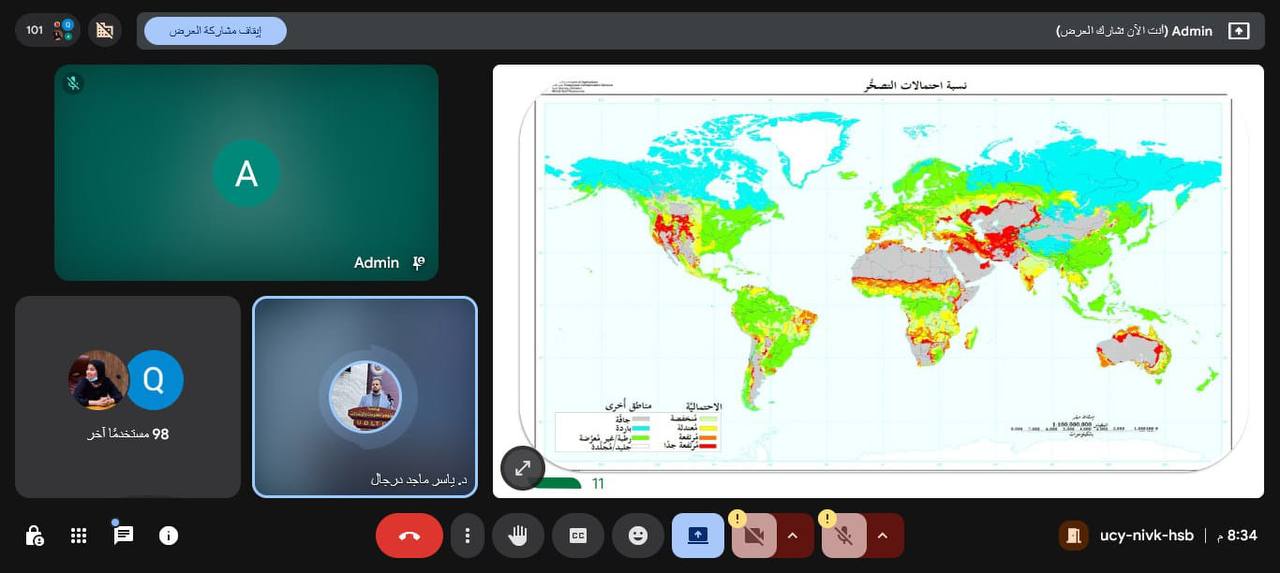

The University of Information Technology and Communications held an online scientific workshop entitled “Desertification and its repercussions on environmental security”, presented by the head of the University’s psychological counseling division, Lect. Dr. Yasser Majed Dirjal, in cooperation with Lect. Dr. Younes Taleb Shehab from the Nineveh Education Directorate.
The workshop, organized by the Continuous Education Center in cooperation with the University Psychological Counseling Division, addressed the concept of desertification and its causes, in addition to classifying its degrees and the resulting environmental, economic and social effects.
The reality of desertification in Iraq was also discussed as a prominent example of contemporary environmental challenges.
The two lecturers addressed the relationship between desertification and environmental security, explaining how desertification poses a direct threat to global environmental security and affects the paths of sustainable development.
The workshop also reviewed the role of modern digital technologies in monitoring and reducing desertification, through the use of Geographic Information Systems (GIS) and remote sensing technologies in monitoring environmental changes, as well as highlighting the role of Artificial Intelligence (AI) and the Internet of Things (IoT) as innovative tools to address desertification.
The workshop emphasized that adopting these advanced technologies represents an important strategic step towards confronting the phenomenon of desertification, as they provide proactive diagnostic capabilities, early warning, and more effective treatments, which contributes to enhancing natural resource management and achieving sustainable development goals.