
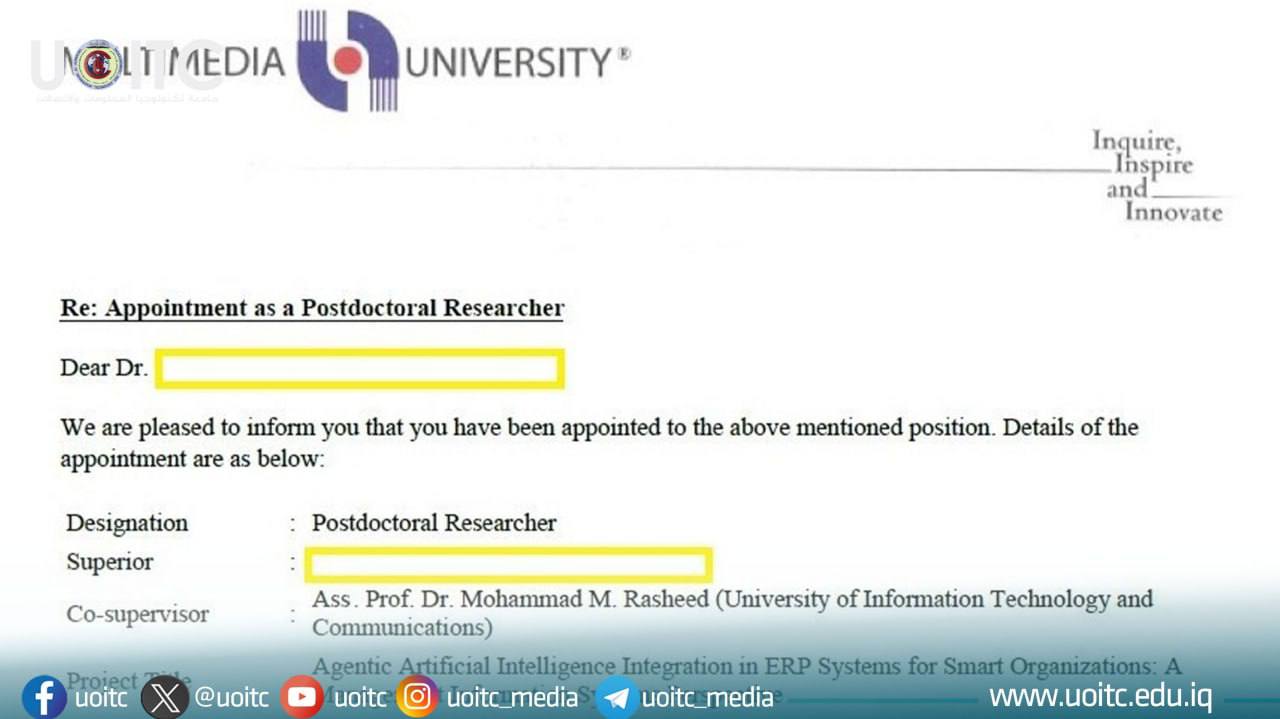
Assistant Professor Dr. Mohammed Maher Rashid, a faculty member at the College of Engineering, participated in the Sixth International Conference on Computer, Information Technology, and Intelligent Computing (CITIC 2026), held in Cyberjaya, Malaysia, from May 5 to 7, 2026. He presented his scientific research titled:
“Beyond Autoencoders: A Hierarchical Memory Framework for Unsupervised Network Intrusion Detection.”
The research addressed one of the most significant challenges in the field of network security, which is the unsupervised detection of intrusion attacks without relying on pre-labeled data. It proposed an innovative framework based on the concept of hierarchical memory inspired by the functioning of the human brain, integrating three levels: short-term memory, working memory, and associative memory.
The importance of this research lies in its proposal of an advanced architectural alternative that goes beyond the limitations of traditional models based on autoencoders, particularly in dealing with emerging attack patterns, as well as addressing an existing research gap in this vital field.
The research featured several modern scientific contributions, most notably the introduction of a three-layer hierarchical memory structure for the first time in the field of network intrusion detection, and the adoption of a practical unsupervised approach. Additionally, it employed a synergistic integration of Gaussian mixture models and locally sensitive hashing techniques along with graphical neural networks, subjecting the model to rigorous testing using multiple datasets according to standards that ensure reproducibility and scientific validation.
The research is expected to be published in the conference proceedings in a special volume issued by the American Institute of Physics, indexed in both Scopus and Web of Science databases, thereby enhancing its academic presence on an international level.