
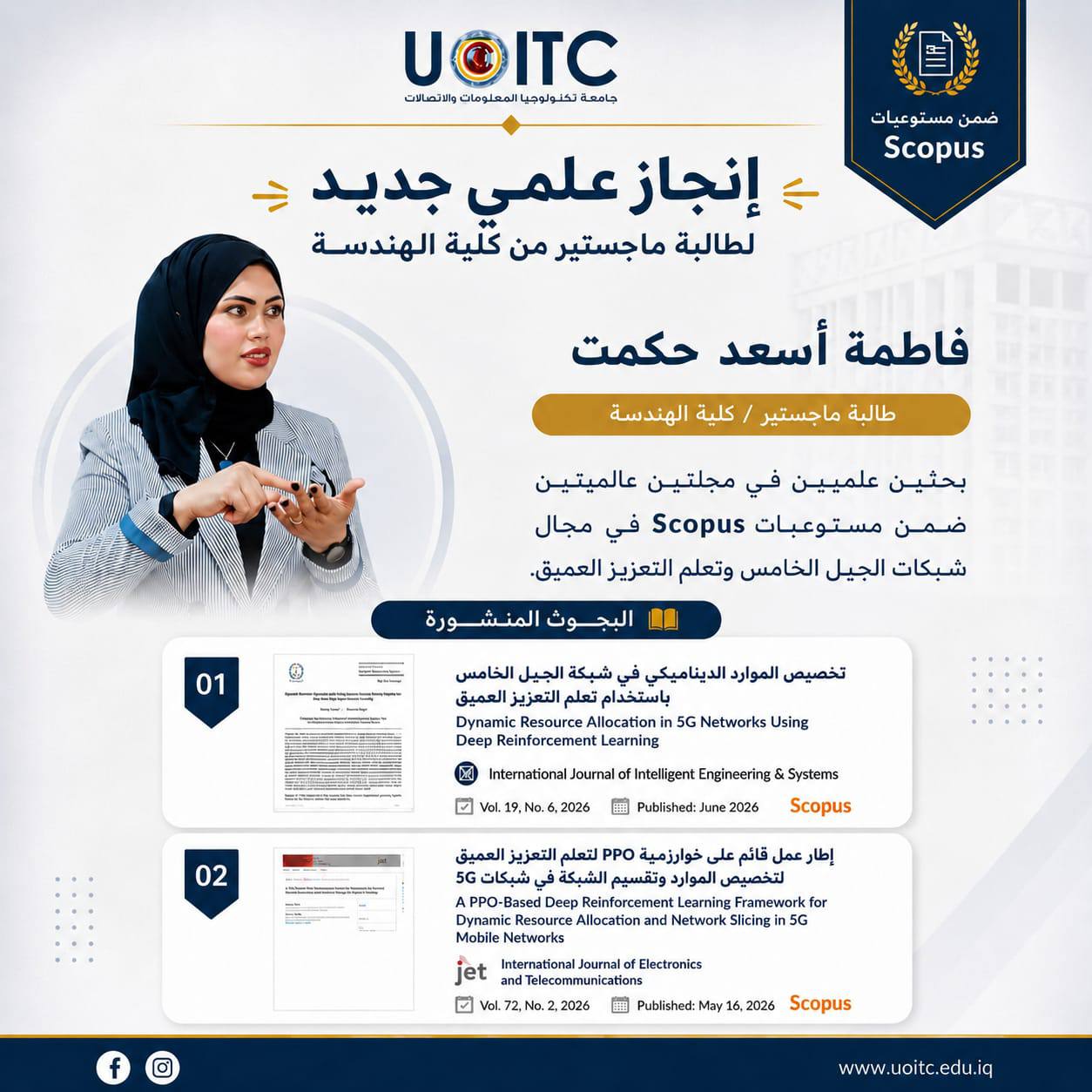
Fatima Asaad Hikmat, a Master’s student at the College of Engineering, University of Information Technology and Communications, has successfully published two scientific research papers in prestigious international journals indexed within the global Scopus database. The research was supervised by the Dean of the College, Professor Dr. Moayed Abdul-Redha Sahib.
This achievement reflects the advanced level of postgraduate students at the university and their ability to contribute to the production of scientific research with an international academic impact. The two papers were published in journals classified within the second (Q2) and third (Q3) quartiles, thereby enhancing the university’s presence in the fields of reputable scientific publishing.
The research addressed the development of intelligent models utilizing Deep Reinforcement Learning (DRL) techniques for resource management and network slicing in fifth-generation (5G) networks. This aims to improve network efficiency and the Quality of Service (QoS) provided to users by employing the latest artificial intelligence technologies in the telecommunications sector.
This success underscores the excellence of research outputs by students of the University of Information Technology and Communications and their active role in enriching scientific knowledge with innovative solutions that help address contemporary technical challenges, boosting the academic standing of the university at both local and international levels.
The first paper, titled:
“A PPO-Based Deep Reinforcement Learning Framework for Dynamic Resource Allocation and Network Slicing in 5G Mobile Networks”
was published in the International Journal of Electronics and Telecommunications, which is classified within the third quartile (Q3). Meanwhile, the second paper, titled:
“Dynamic Resource Allocation with Priority-aware Network Slicing in Multi-base Station 5G Using Deep Reinforcement Learning”
was published in the International Journal of Intelligent Engineering & Systems (IJIES), which is classified within the second quartile (Q2).