
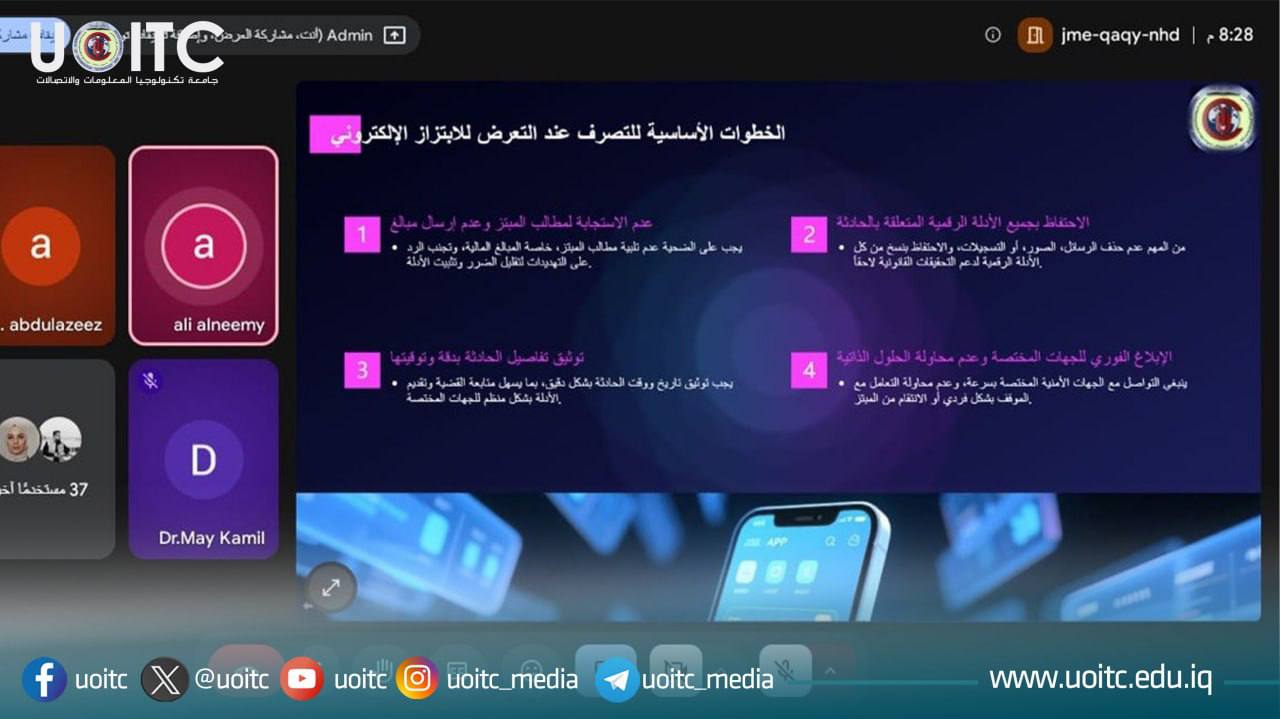
In implementation of the pillars of the Iraqi National Security Strategy (Iraq First) 2025–2030, the University’s Psychological Counseling Division, in cooperation with the Continuing Education Center at the University of Information Technology and Communications (UoITC), organized an electronic seminar titled “The Role of Educational Institutions in Reducing Cyber-Extortion Crimes.”
The seminar was presented by Asst. Lect. Esraa Saad, Asst. Lect. Asma Abdul-Aziz, and Asst. Lect. Ali Munther.
The seminar reviewed the concept of cyber-extortion, its most prominent forms and methods, and the causes contributing to its spread—foremost among which are weak digital awareness, the unsafe use of social media platforms, and the excessive sharing of personal information and data, as well as the exploitation of technological advancements to execute extortion operations.
Additionally, the seminar addressed the psychological, social, and familial impacts resulting from these crimes and their repercussions on the stability of individuals and society, emphasizing the importance of enhancing electronic awareness and adopting safe digital behaviors to mitigate their risks.
Furthermore, the seminar highlighted the pivotal role of educational institutions in combating cyber-extortion by spreading digital culture among students, organizing educational seminars and programs, and instilling the principles of safe internet usage, thereby contributing to creating a safer learning environment capable of facing digital challenges.
The seminar concluded by outlining the mechanisms for reporting cyber-extortion cases.
It emphasized the vital importance of prompt reporting through official channels, refusing to comply with extortionists’ demands, and preserving digital evidence to ensure necessary legal actions are taken. The seminar witnessed active engagement from the audience through interventions and inquiries that underscored the importance of continuing awareness programs to strengthen cyber security within the university community.