
University Organizes an Electronic Scientific Workshop on Academic Promotions and Administrative Procedures
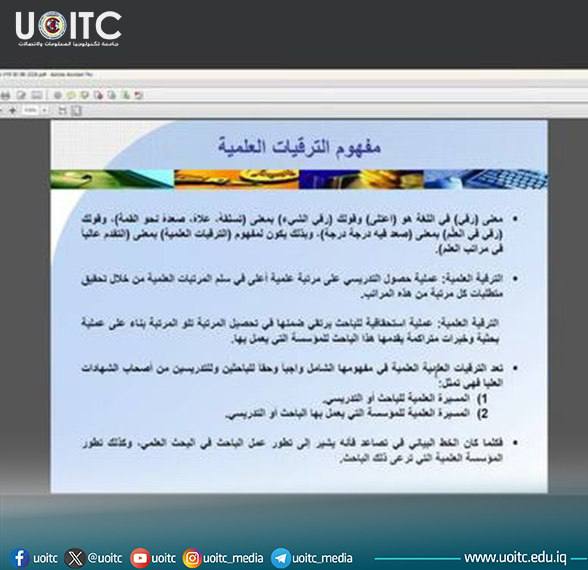
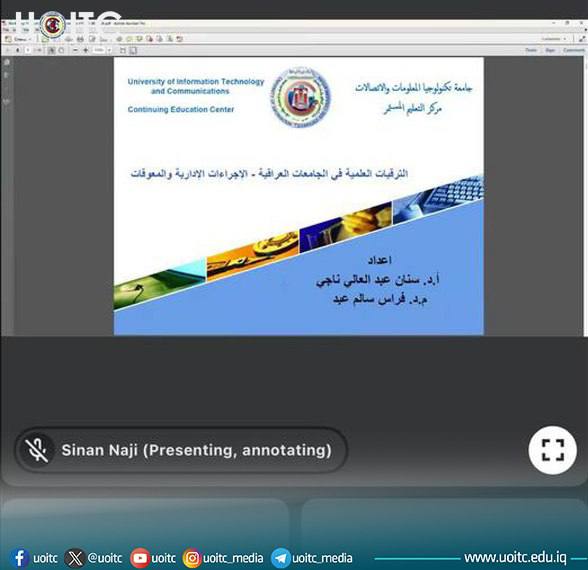
The Continuing Education Center, in cooperation with the Department of Postgraduate Affairs at the University of Information Technology and Communications (UOITC), organized an electronic scientific workshop titled “Academic Promotions in Iraqi Universities: Administrative Procedures and Obstacles.” The workshop was presented by Prof. Dr. Sinan Abdul-Aali Naji and Lecturer Dr. Firas Salem Abed.The workshop addressed several scientific and administrative tracks related to academic promotions. It commenced with an overview of the concept and significance of academic promotions, highlighting their linguistic and academic dimensions as a cumulative merit pathway. This process reflects the scientific and research development of faculty members and researchers, thereby enhancing the quality of academic performance within the educational institution.Furthermore, the presenters reviewed the historical development of academic promotion regulations in Iraqi universities, starting from Regulation No. (36) of 1992 up to Regulation No. (167) of 2017 issued by the Ministry of Higher Education and Scientific Research (MOHESR). They clarified the most prominent governing articles, guidelines, and implementation mechanisms in academic promotion transactions.The workshop also examined the key challenges and obstacles facing academic promotion processes by analyzing the strengths and weaknesses of current procedures. It discussed several issues regarding the interpretation of texts and regulations, the phrasing of certain articles, the criteria for determining general and specific specializations, the trajectory of scientific research, and the specific procedures applicable to faculty and researchers transferred from outside the Ministry.In another session, the workshop covered guidelines for scientific publishing, academic registration, and accreditation. It emphasized avoiding unrecognized or unregistered websites and journals, while introducing predatory journals and warning registries—such as Beall’s List—to help protect researchers’ scientific output and ensure the integrity of publishing and accreditation procedures.