
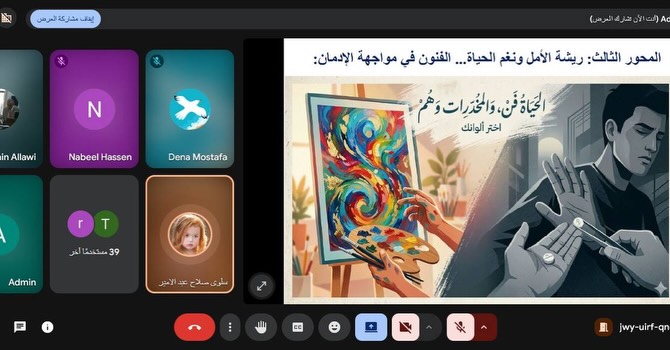

The University Psychological Counseling Division at the University of Information Technology and Communications organized an online seminar titled: “The Role of Art as a Soft Power in Preventing Drug Abuse.”The seminar included three main topics and was presented by Assistant Lecturers Sara Fadel, Dina Mustafa, and Salwa Salah. It aimed to shed light on the phenomenon of drug abuse and to highlight ways of prevention through indirect means of influence, foremost among them art and soft power.
The first section, titled “Drugs: From Temptation to Ruin,” addressed the concept of drugs and their scientific classifications. It also reviewed the main causes and motivations behind drug use, such as curiosity, the desire to experiment, and escaping psychological pressures like depression and anxiety, in addition to family, social, and media-related factors. The section further highlighted the serious health and social consequences resulting from drug abuse.
The second section, titled “Soft Power: Building Awareness and Creating Influence,” focused on the concept of soft power as one of the most prominent tools of societal influence, as it relies on persuasion and attraction rather than coercion. It also explained its role in shaping influence through culture, the arts, education, and media, contributing to enhancing societal awareness and achieving positive change through peaceful means.
The third section, titled “The Brush of Hope and the Melody of Life: Arts in Confronting Addiction,” explored the role of the arts in their various forms in preventing addiction. This included visual arts such as painting, sculpture, and photography; performing arts like theater and cinema; as well as auditory arts such as music and poetry. It emphasized the importance of these mediums in fostering positive expression and enhancing mental well-being.
The seminar concluded with a set of recommendations, most notably expanding the use of the arts as an awareness-raising tool within educational institutions, activating the role of the media in delivering meaningful messages through creative approaches, and strengthening cooperation between educational and cultural institutions to combat the phenomenon of drug abuse. It also recommended organizing workshops and training programs that contribute to developing students’ psychological and social awareness.