
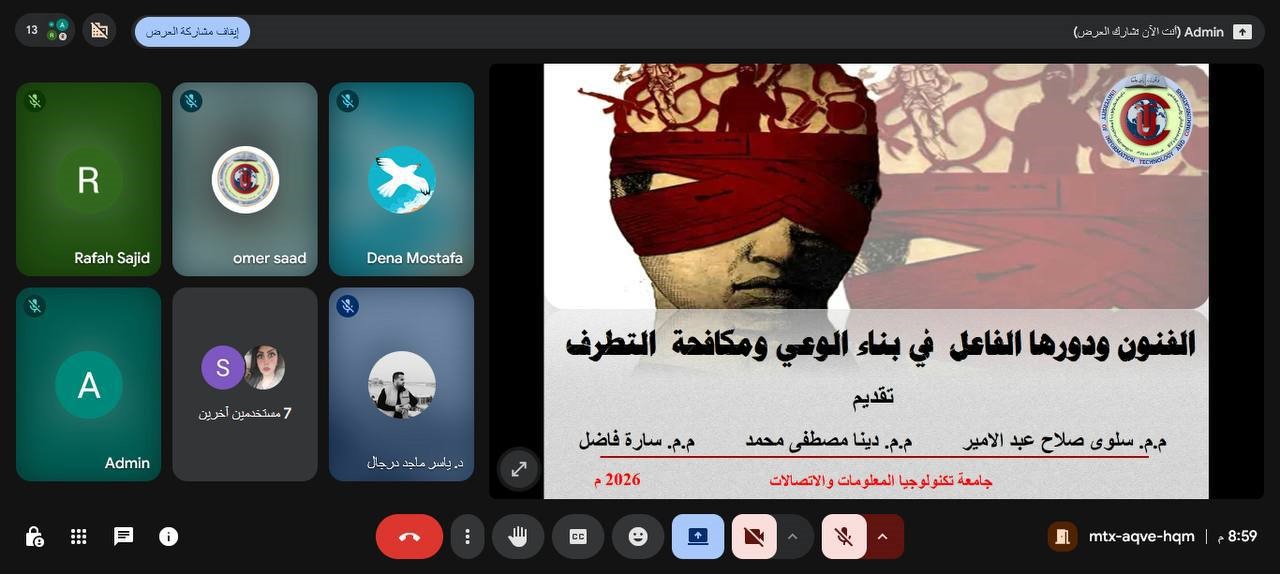
UoITC holds an Online Workshop on the Role of the Arts in Building Awareness and Combating Extremism
The University Psychological Counseling Division, in cooperation with the Continuing Education Center (CEC) at the University of Information Technology and Communications (UoITC), held an online workshop titled “The Arts and Their Effective Role in Building Awareness and Combating Extremism.” It was presented by Assistant Lecturers Salwa Salah Abdul Amir, Dina Mustafa Mohammed, and Sara Fadhil.
The workshop aimed to highlight the role of art as an influential tool in promoting societal awareness and addressing the phenomenon of extremism, by offering scientific and practical insights that contribute to reinforcing the values of peaceful coexistence and building peace.
The workshop addressed several key topics, most notably the concept of extremism, its causes, and its characteristics. It also explained the role of art in developing critical thinking, reshaping values, and opening up avenues for cultural dialogue. Additionally, it emphasized the importance of using the arts as an effective human-centered means to counter extremist ideology, given their psychological and cognitive impact in promoting a culture of diversity and openness.
The workshop concluded with a set of recommendations, including the use of the arts in intellectual rehabilitation programs, organizing art exhibitions that promote societal awareness, and supporting youth-focused artistic initiatives—all of which contribute to reducing manifestations of extremism and building a more tolerant society.
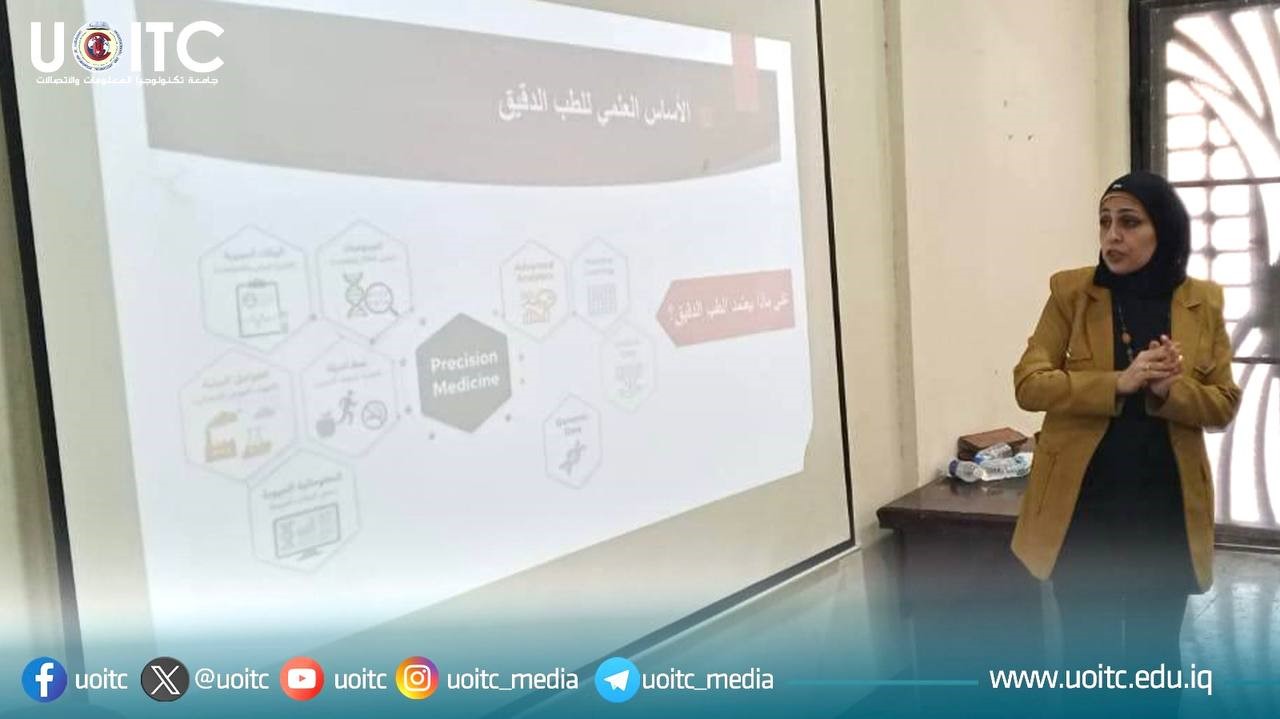
CBMI Organizes a Seminar on Personalized Treatment Based on Genetic Profiling and Applications of Precision Medicine
The College of Biomedical Informatics (CBMI) at the University of Information Technology and Communications (UoITC) organized a scientific seminar titled “Personalizing Treatment Based on Genetic Profiling and Applications of Precision Medicine in Healthcare”.
The seminar, presented by Lecturer Dr. Nada Nizar Kazem, addressed the concept of precision medicine and its importance in enhancing the accuracy of diagnosis and treatment by relying on the analysis of genes and clinical data, thereby contributing to the development of personalized treatment plans for each patient.
The seminar also reviewed the differences between traditional medicine and precision medicine, and highlighted its most prominent clinical applications, particularly in cancer treatment and drug development. It also emphasized the vital role of bioinformatics in analyzing genetic data and linking it to appropriate therapeutic decision-making.
The seminar also addressed several international experiences in the application of precision medicine, along with a discussion of the current state of this field in Iraq and the challenges facing its development. It was emphasized that precision medicine represents one of the most important directions in the future of modern healthcare, as it offers opportunities to improve the quality of medical services and treatment outcomes.
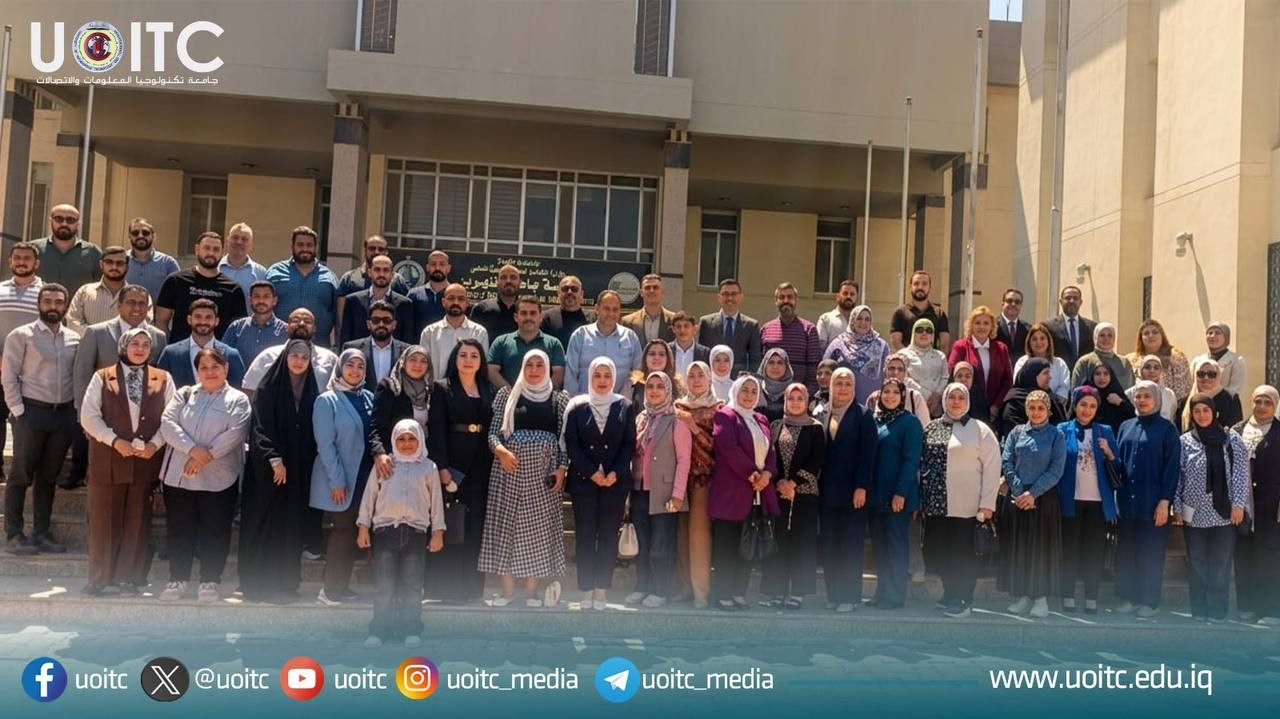
University Staff Conclude Training Course at Al-Nahrain University
The first group of newly appointed employees at the University of Information Technology and Communications has completed its participation in a training course held at Al-Nahrain University, as part of a preparatory program aimed at developing their skills and enhancing their readiness for work.
The course, titled “Job Behavior and Institutional Loyalty,” was organized in accordance with the directives of the Office of the Prime Minister and the instructions of the Ministry of Higher Education and Scientific Research, which emphasized the importance of enrolling newly appointed staff in training courses conducted at accredited centers, including the Training Center at Al-Nahrain University. This initiative contributes to improving their efficiency and developing their professional capabilities.
The course featured rich discussions addressing key aspects of administrative and professional work. Among the most prominent topics were job loyalty and institutional belonging, highlighting how work can be transformed from a routine duty into a sense of responsibility and genuine partnership in success. Leadership versus management was also discussed by outlining the fundamental differences between a leader who inspires the team and shapes vision, and a manager who focuses on executing processes and maintaining systems.
Professional ethics were explored through an analysis of the sources of professional values, examining whether they are rooted in religious and moral principles, legal frameworks and regulations, or social norms and traditions. The course also reviewed various types of management and categorized employee styles according to their behaviors and productivity, along with effective administrative approaches to deal with them.
The program aimed to empower participants to understand their rights and ethical responsibilities, while equipping leaders with the necessary tools to create a motivating work environment based on mutual respect and institutional loyalty. This, in turn, positively reflects on the quality of outcomes and the sustainability of excellence.
All Of US
Pages
- About Center of Continuing Education
- About Engineering
- About Us
- About_us_bic
- administrative Departments
- Archive
- Assistant Rector for Administrative Affairs
- Assistant Rector for Scientific Affairs
- Bioinformatics Department
- Business Informatic College
- Business Informatics college courses
- Business Informatics college News
- Campus
- Center for Continuing Education
- Center for Continuing Education News
- Citizens Affairs
- College of Biomedical Informatics
- College of Engineering
- College of Medical Courses
- College of Medical News
- Contact Us
- Contact Us
- Contact Us Form
- contact_us_bic
- contact_us_cec
- Courses
- Deans Of Colleges
- Department of Media and Government Communication
- departments_cec
- Download Center
- Electronic Computer Center
- Embed External Page
- Eng test
- Engineering Contact Us
- Engineering Courses
- Engineering Events
- Engineering News
- Engineering Students
- events_cec
- Fellowship Programs
- Goal 1: End poverty in all its forms everywhere
- Goal 10: Reduced Inequalities
- Goal 11: Sustainable Cities and Communities
- Goal 12: Responsible Consumption and Production
- Goal 13: Climate Action
- Goal 14: Life Below Water
- Goal 15: Life on Land
- Goal 16: Peace, Justice and Strong Institutions
- Goal 17: Partnerships for The Goals
- Goal 2: Zero Hunger
- Goal 3: Ensure healthy lives and promote well-being for all at all ages
- Goal 4: Quality Education
- Goal 5: Gender Equality
- Goal 6: Ensure access to water and sanitation for all
- Goal 7: Ensure access to affordable, reliable, sustainable and modern energy
- Goal 8: Decent Work and Economic Growth
- Goal 9: Industry, Innovation and Infrastructure
- intellgent media system
- Intelligent Medical Systems Department
- International Open Courses
- International Students
- ism department
- lastnews
- Latest News
- mc_EVENTS
- mc_Students
- Media and Documents
- Media and Documents ( Cloned )
- Media Technology and Communications Engineering Department
- Medical College Page
- Mobile Communications and Computing Engineering Department
- News
- Performance Evaluation Forms 2023-2024
- Post-Graduate of Engineering
- Presidency departments
- President of University
- Quality Assurance Archive
- Quality Assurance Department
- Related Websites
- Scholarships and Cultural Relations Department
- Scholarships for Foreign Students
- Scholarships for Foreign Students 2025- 2026
- Scientific Affairs Departments
- Services
- SiteMap
- statistics_cec
- Structural uoitc
- Supporting innovation by generating new ideas to enhance creativity and develop the institutional work of university staff
- Sustainability Website
- Technology incubator
- test10
- test100
- test11
- Test22
- University
- University and Community
- university and society
- University and Students
- University Council Secretariat
- University Home
- UoITC Rank
- Women’s Affairs
- الرئيسية 2