College of Biomedical Informatics Highlights Dimensions of UN Resolution 1325 on Women, Peace, and Security
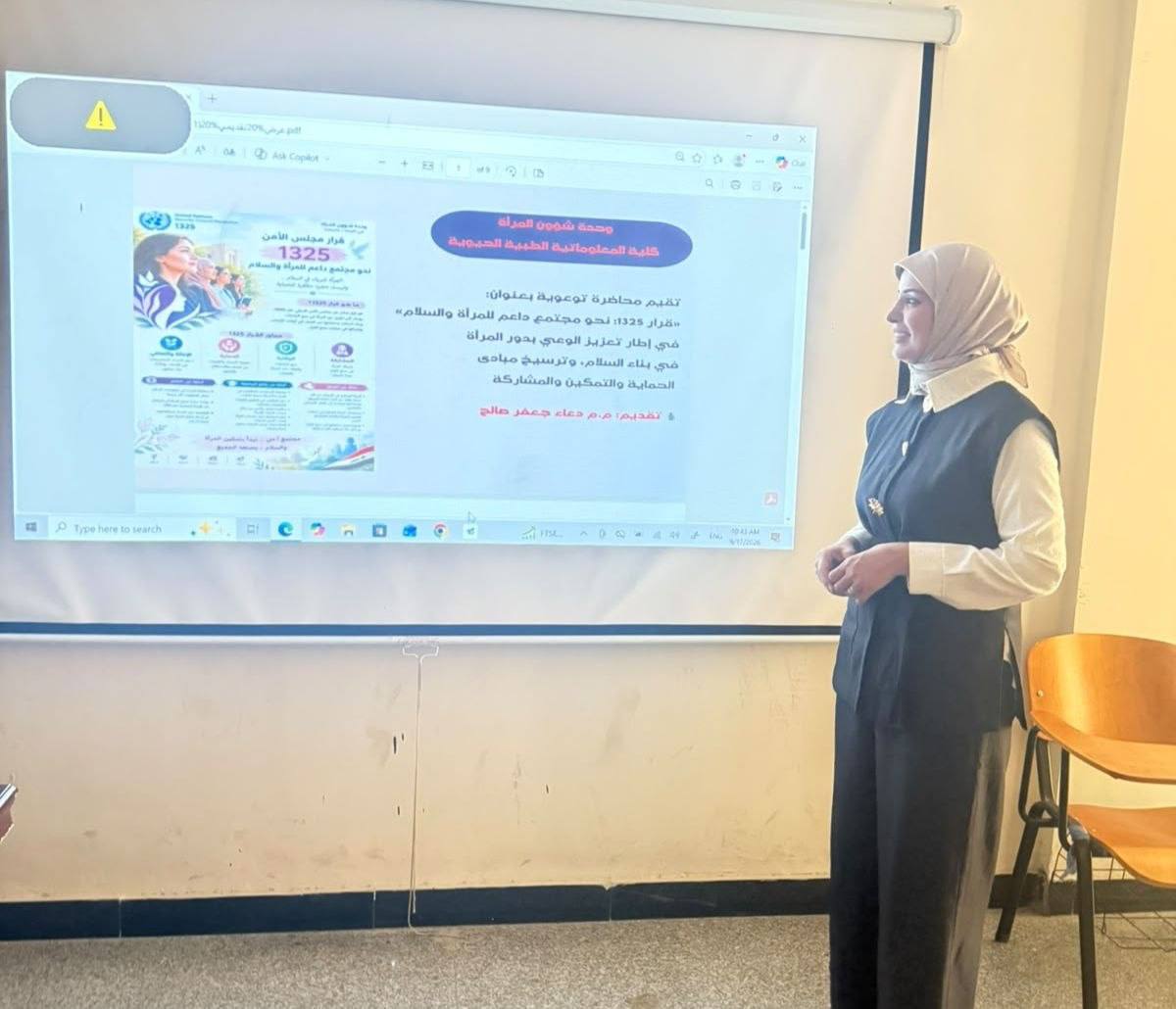
The Women’s Affairs Unit at the College of Biomedical Informatics, University of Information Technology and Communications, organized an awareness lecture titled “Resolution 1325: Towards a Supportive Society for Women and Peace.” The event was attended by several faculty members and was held as part of ongoing efforts to enhance community and rights awareness regarding women’s issues and their role in peacebuilding.
The lecture was delivered by Assistant Lecturer Duaa Jaafar Saleh, who introduced UN Security Council Resolution 1325 on Women, Peace, and Security. She highlighted its vital importance in strengthening women’s presence and participation in conflict prevention, resolution, and sustainable peacebuilding efforts.
Furthermore, the lecture reviewed the core pillars of the resolution, namely: Protection, Empowerment, Participation, and Prevention. It emphasized the necessity of ensuring full and equal participation of women in decision-making processes, conflict prevention and resolution, as well as advancing paths for peace and community development.
The speaker concluded by stressing the importance of integrating academic and community efforts to foster a safe and supportive environment. Such an environment enables women to play an active role in various fields, ultimately contributing to enhancing stability and building a more inclusive and balanced society.
The University of Information Technology and Communications organized an awareness workshop on the dangers of drugs
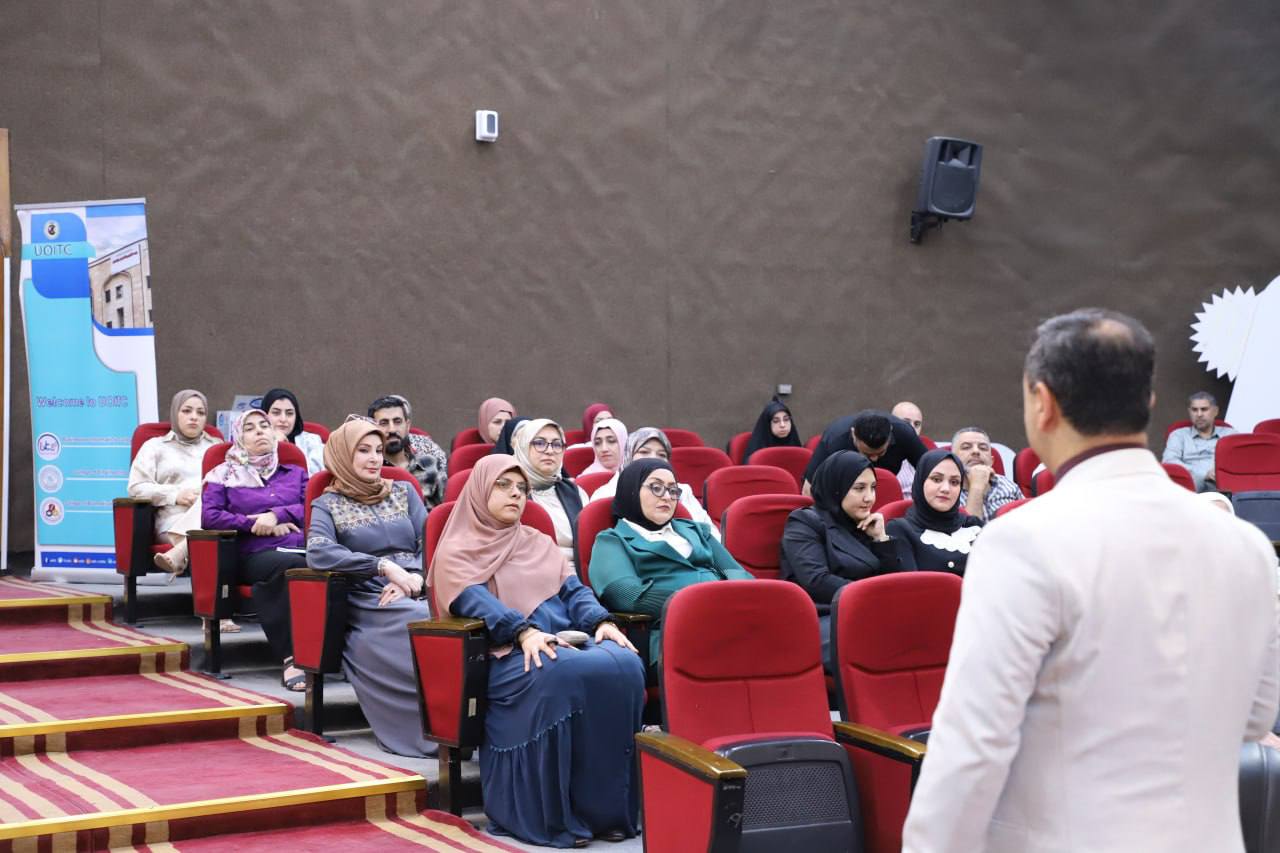
The University Psychological Counseling Division at the University of Information Technology and Communications, in cooperation with the Iraqi National Security Service, organized an awareness workshop addressing the dangers of drugs and their impact on the individual and society, as part of efforts to foster community awareness and prevent this scourge.
The workshop, conducted by specialists from the Iraqi National Security Service, included an overview of the types and classifications of narcotics—specifically those of natural and synthetic origins—as well as a review of key legal aspects regarding drug-related offenses and their associated penalties, and it also addressed the health and social impacts affecting users, their families, and society at large.
The workshop also featured the screening of a series of awareness-raising videos addressing the mechanisms for handling drug-related crimes and the procedures for apprehending suspects, thereby helping to raise awareness of the dangers associated with these crimes and ways to curb their spread.
The workshop concluded by introducing the means of communication and reporting regarding drug-related cases and activities—including the Iraqi National Security Service’s hotline (131)—as a reporting channel that contributes to supporting security efforts and enhancing community protection.
The University Contributes to Supporting the Arba’een Pilgrimage by Deploying Vehicles to Transport Pilgrims to and from Holy Karbala
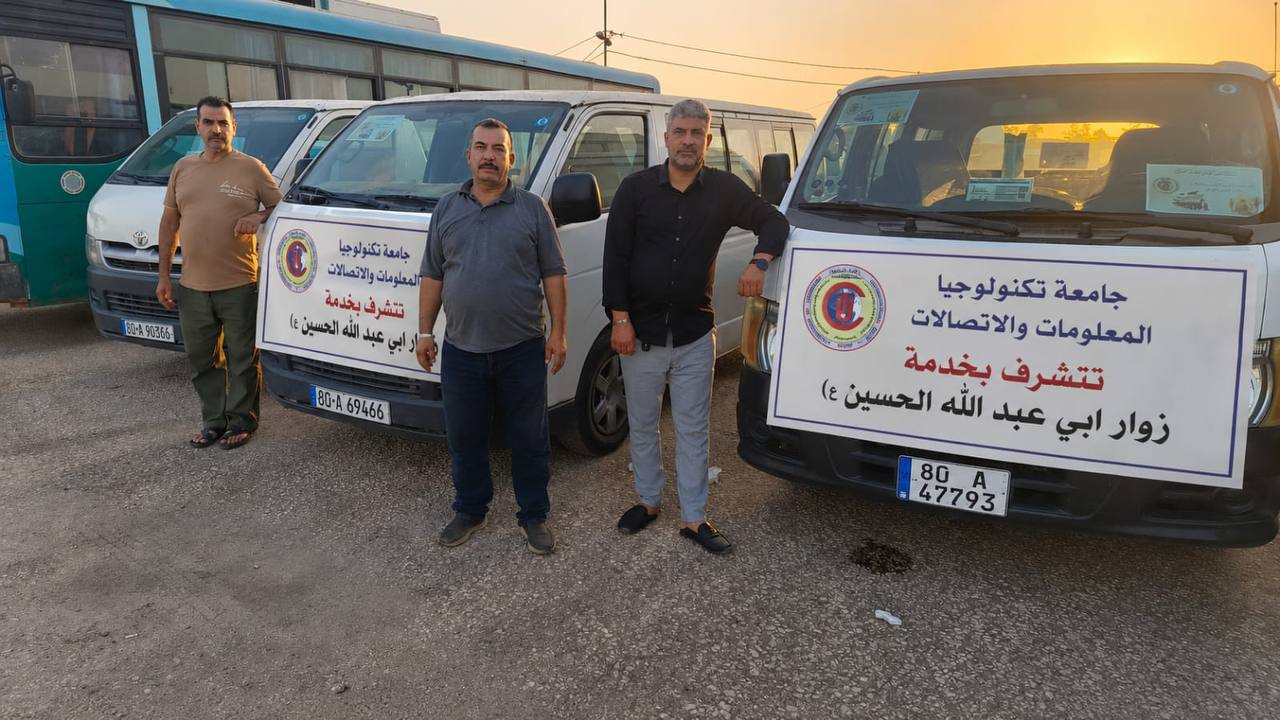
As part of its social responsibility and its contribution to supporting national efforts aimed at serving pilgrims visiting the shrine of Imam Hussein (peace be upon him), the University of Information Technology and Communications has begun deploying a number of its vehicles to transport pilgrims to and from the holy city of Karbala, thus facilitating transportation during the Arba’een pilgrimage.
This initiative aligns with government directives supporting the success of the Arba’een pilgrimage and embodies the spirit of solidarity and cooperation in serving the pilgrims, by harnessing the university’s resources to contribute to providing the best possible services during this blessed occasion.
The university administration affirmed that this participation reflects the university’s commitment to fulfilling its national and humanitarian role alongside state institutions, and its support for efforts to provide suitable transportation for pilgrims, thereby contributing to the smooth flow of movement and enhancing the quality of services provided to them.
We ask God Almighty to accept everyone’s good deeds, to protect Iraq and its people, and to grant success to all those involved in serving the pilgrims of Imam Hussein (peace be upon him).
All Of US
Pages
- About Center of Continuing Education
- About Engineering
- About Us
- About_us_bic
- administrative Departments
- Archive
- Assistant Rector for Administrative Affairs
- Assistant Rector for Scientific Affairs
- Bioinformatics Department
- Business Informatic College
- Business Informatics college courses
- Business Informatics college News
- Campus
- Center for Continuing Education
- Center for Continuing Education News
- Citizens Affairs
- College of Biomedical Informatics
- College of Engineering
- College of Medical Courses
- College of Medical News
- Contact Us
- Contact Us
- Contact Us Form
- contact_us_bic
- contact_us_cec
- Courses
- Deans Of Colleges
- Department of Media and Government Communication
- departments_cec
- Download Center
- Electronic Computer Center
- Embed External Page
- Eng test
- Engineering Contact Us
- Engineering Courses
- Engineering Events
- Engineering News
- Engineering Students
- events_cec
- Fellowship Programs
- Goal 1: End poverty in all its forms everywhere
- Goal 10: Reduced Inequalities
- Goal 11: Sustainable Cities and Communities
- Goal 12: Responsible Consumption and Production
- Goal 13: Climate Action
- Goal 14: Life Below Water
- Goal 15: Life on Land
- Goal 16: Peace, Justice and Strong Institutions
- Goal 17: Partnerships for The Goals
- Goal 2: Zero Hunger
- Goal 3: Ensure healthy lives and promote well-being for all at all ages
- Goal 4: Quality Education
- Goal 5: Gender Equality
- Goal 6: Ensure access to water and sanitation for all
- Goal 7: Ensure access to affordable, reliable, sustainable and modern energy
- Goal 8: Decent Work and Economic Growth
- Goal 9: Industry, Innovation and Infrastructure
- intellgent media system
- Intelligent Medical Systems Department
- International Open Courses
- International Students
- ism department
- lastnews
- Latest News
- mc_EVENTS
- mc_Students
- Media and Documents
- Media and Documents ( Cloned )
- Media Technology and Communications Engineering Department
- Medical College Page
- Mobile Communications and Computing Engineering Department
- News
- Performance Evaluation Forms 2023-2024
- Post-Graduate of Engineering
- Presidency departments
- President of University
- Quality Assurance Archive
- Quality Assurance Department
- Related Websites
- Scholarships and Cultural Relations Department
- Scholarships for Foreign Students
- Scholarships for Foreign Students 2025- 2026
- Scientific Affairs Departments
- Services
- SiteMap
- statistics_cec
- Structural uoitc
- Supporting innovation by generating new ideas to enhance creativity and develop the institutional work of university staff
- Sustainability Website
- Technology incubator
- test10
- test100
- test11
- Test22
- University
- University and Community
- university and society
- University and Students
- University Council Secretariat
- University Home
- UoITC Rank
- Women’s Affairs
- الرئيسية 2