
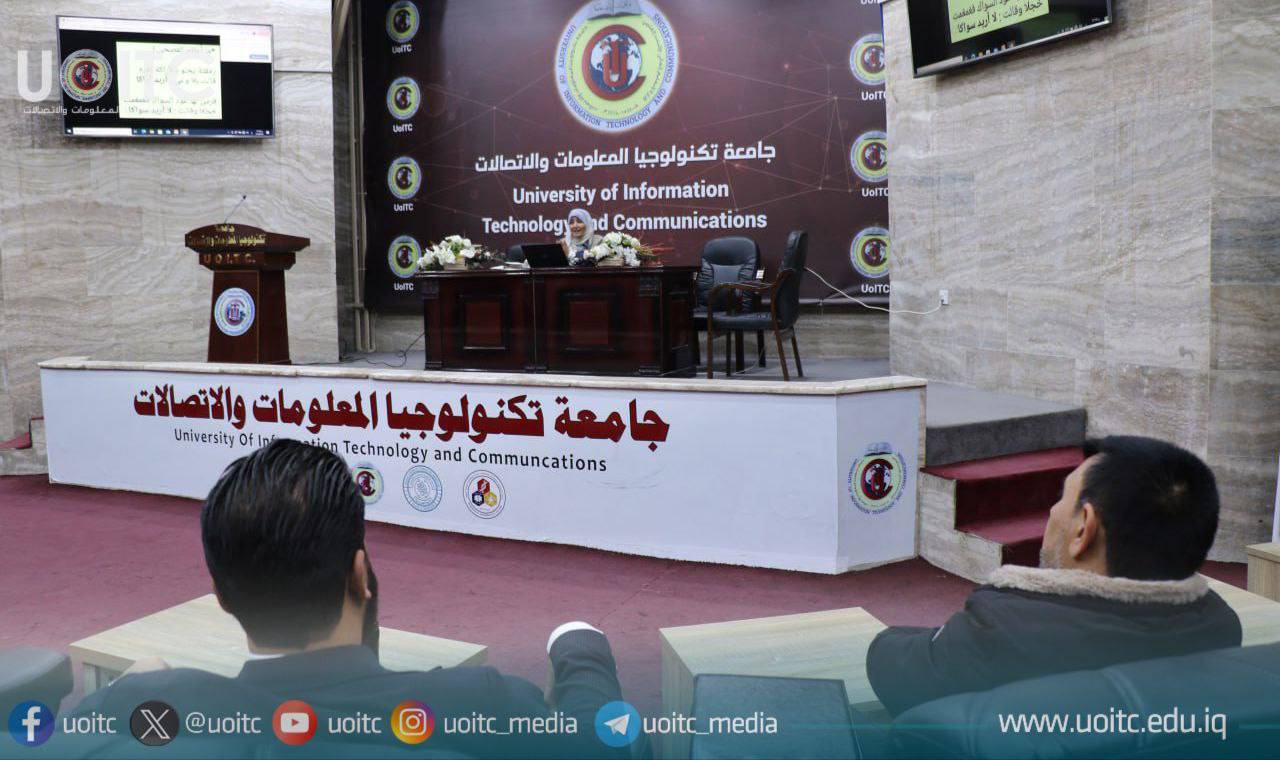
The Business Informatics College organized a seminar on the Arabic language: Concerns and Aspirations
The Business Informatics College, in cooperation with the Continuous Education Center at the University of Information Technology and Communications, organized a scientific seminar entitled “The Arabic Language: Concerns and Aspirations,” as part of the University’s interest in promoting the status of the Arabic language and maintaining its presence in scientific, academic and community fields.
The seminar, presented by Dr. Lubna Abdul Aziz from the Business Informatics College, addressed the most prominent risks facing the Arabic language at the present time, most notably
its distancing from the scientific and literary scene, its distancing from daily use, as well as the replacement of it by foreign languages and local dialects, in addition to the widespread misuse of linguistic structures, grammar, and spelling rules.
The symposium also reviewed a number of reasons that contributed to the decline in the status of the Arabic language, including distancing oneself from religious values, excessive fascination with foreign languages and the resulting imbalance in standards of excellence, as well as the belittling of the language by its own people, and the weakness of some of those in charge of teaching it as a result of the weakness of the educational system.
The symposium presented a set of practical proposals for the advancement of the Arabic language, most notably allocating a day of the week for speaking classical Arabic, and trying to replace foreign vocabulary with Arabic vocabulary, even if it is less common, in addition to encouraging and rewarding family members when they use Arabic vocabulary, and teaching children proverbs or easy-to-memorize verses of poetry, as this contributes to establishing the language in their daily lives.
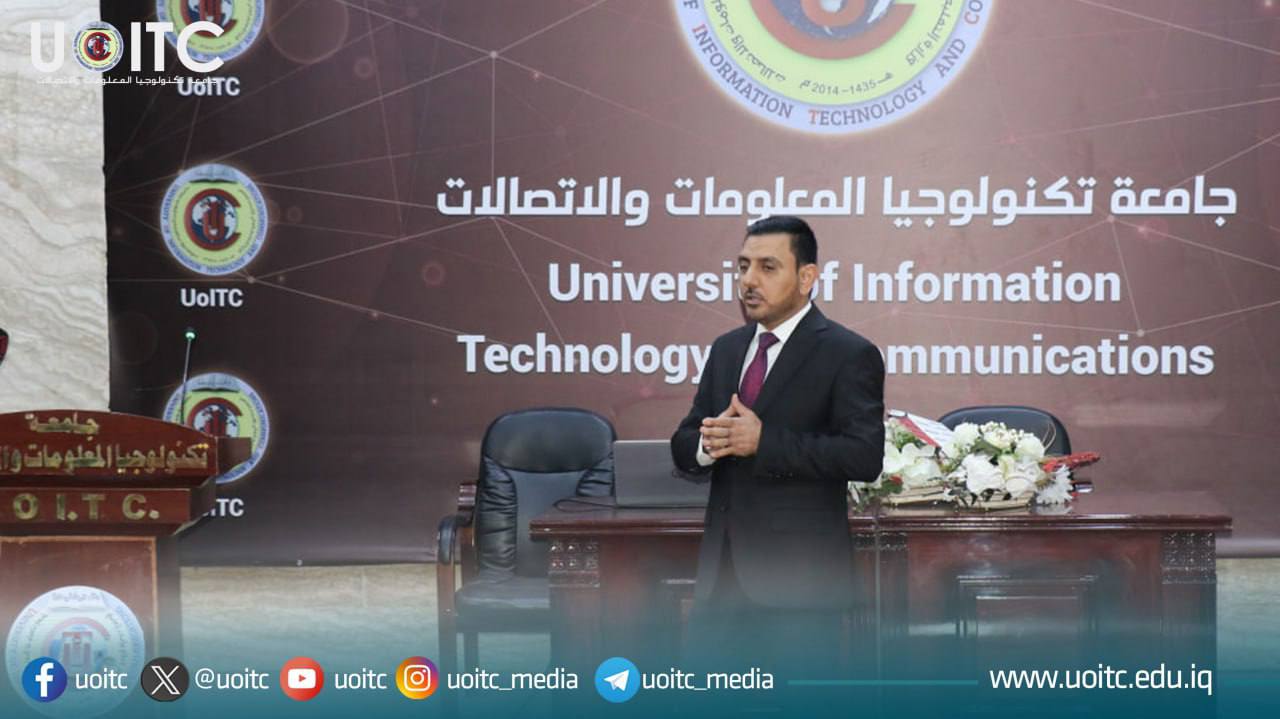
The College of Business Informatics at the University of Information Technology and Communications organized an educational seminar entitled “The Imam Hussein (PBUH) Project for All: A Humanistic and Global Vision
The College of Business Informatics at the University of Information Technology and Communications organized an educational seminar entitled “The Imam Hussein (PBUH) Project for All: A Humanistic and Global Vision
The seminar was presented by Lecturer Saif Adel Al-Hamdani and attended by a number of faculty members and students.
The seminar addressed the pivotal role of universities and youth in disseminating the principles and revolution of Imam Hussein (PBUH), portraying it as a universal humanitarian revolution based on the values of justice, freedom, and reform. The importance of dialogue with different religions and cultures was also highlighted, emphasizing the humanitarian dimension of the Husseini revolution, free from sectarianism.
During the seminar, the lecturer stressed the necessity of adopting Husseini values in the fields of work, education, and community service, given their profound significance in contributing to the development of both the individual and society. The symposium concluded with a number of recommendations, most notably the activation of academic research and studies addressing the universality of the Husseini revolution, supporting responsible media in disseminating the values of Imam Hussein (peace be upon him), integrating Husseini thought into cultural and social activities, and encouraging purposeful youth initiatives.
The symposium demonstrated that the humanitarian message of Imam Hussein (peace be upon him) is capable of contributing to the building of just and conscious societies based on shared moral and human values.
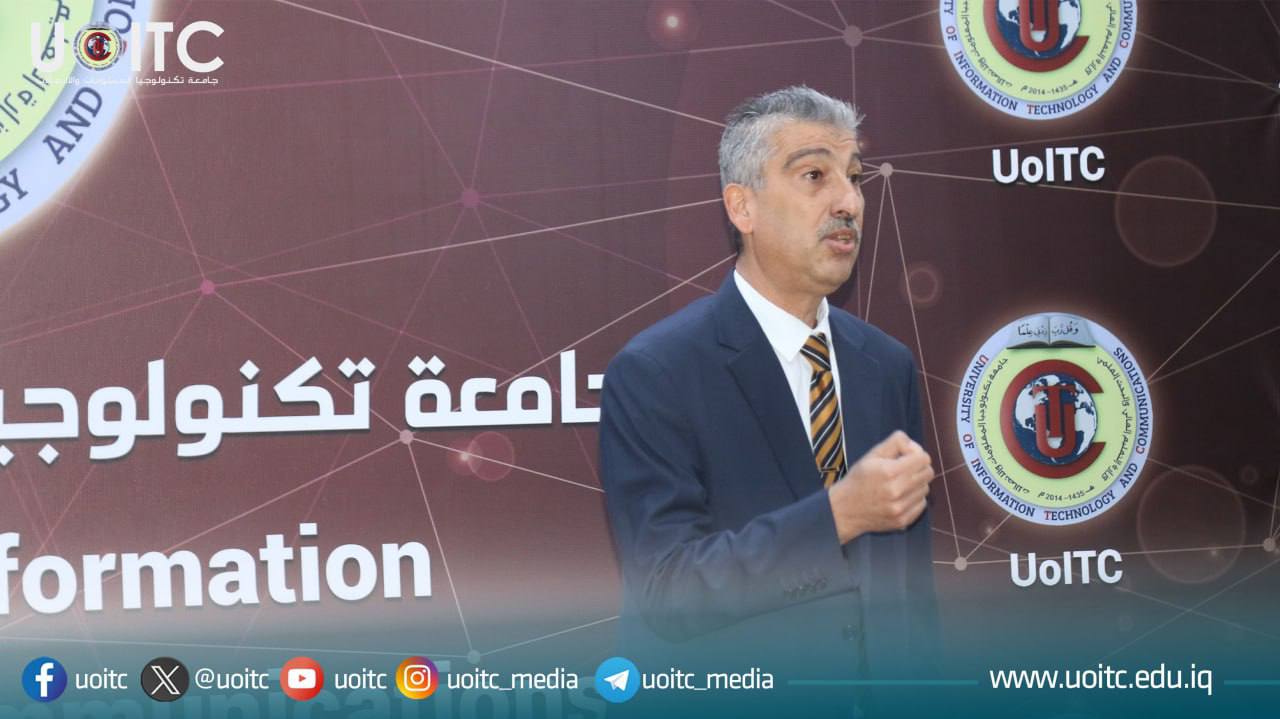
The university organizes a seminar on the culture of tolerance and the rejection of extremism for a safe society
On the occasion of the International Day of Tolerance, the University Psychological Counseling Division organized an educational seminar entitled «A Culture of Tolerance and Rejecting Extremism for a Safe Society», in cooperation with the Scholarships and Cultural Relations Department.
The seminar witnessed two lectures presented by Dr. Iyad Tariq Abdel Majeed and T.A Maryam Imad Shaker from the Department of Scholarships and Cultural Relations, which addressed multiple topics that highlight the importance of spreading and promoting a culture of tolerance within the university community.
Dr. Iyad Tariq Abdel Majeed gave a lecture in which he focused on the role of the university in promoting the values of tolerance, stressing that education is one of the most effective areas in consolidating these universal human values, because of its direct impact on building student’s awareness and spreading the culture of peace and coexistence.
The seminar touched on the concepts of peace, brotherhood, love, and rejection of violence, and the necessity of confronting the phenomenon of extremism and removing its roots from the minds of individuals before their behavior, through an effective educational and pedagogical system that contributes to achieving social stability, internal peace, and a sense of security within society.
The seminar addressed the definition of the culture of tolerance as a human principle based on respect for others, acceptance, coexistence, equality, justice, and rejection of fanaticism, in addition to its role in promoting human development, supporting intellectual and civilizational growth, and building bridges of understanding between members of society, while emphasizing that one of the most prominent characteristics of the culture of tolerance is achieving the public interest. The lecturers touched on types of tolerance, including: religious, moral, social, and intellectual tolerance, and its role in building a cohesive and safe society.
All Of US
Pages
- About Center of Continuing Education
- About College of Medical
- About Engineering
- About Us
- About_us_bic
- administrative Departments
- Archive
- Assistant Rector for Administrative Affairs
- Assistant Rector for Scientific Affairs
- Bioinformatics Department
- Business Informatic College
- Business Informatics college courses
- Business Informatics college News
- Campus
- Center for Continuing Education
- Center for Continuing Education News
- Citizens Affairs
- College of Biomedical Informatics
- College of Engineering
- College of Medical Courses
- College of Medical News
- Contact Us
- Contact Us
- Contact Us Form
- contact_us_bic
- contact_us_cec
- Courses
- Deans Of Colleges
- Department of Media and Government Communication
- departments_cec
- Download Center
- Electronic Computer Center
- Embed External Page
- Eng test
- Engineering Contact Us
- Engineering Courses
- Engineering Events
- Engineering News
- Engineering Students
- events_cec
- Fellowship Programs
- Goal 1: End poverty in all its forms everywhere
- Goal 10: Reduced Inequalities
- Goal 11: Sustainable Cities and Communities
- Goal 12: Responsible Consumption and Production
- Goal 13: Climate Action
- Goal 14: Life Below Water
- Goal 15: Life on Land
- Goal 16: Peace, Justice and Strong Institutions
- Goal 17: Partnerships for The Goals
- Goal 2: Zero Hunger
- Goal 3: Ensure healthy lives and promote well-being for all at all ages
- Goal 4: Quality Education
- Goal 5: Gender Equality
- Goal 6: Ensure access to water and sanitation for all
- Goal 7: Ensure access to affordable, reliable, sustainable and modern energy
- Goal 8: Decent Work and Economic Growth
- Goal 9: Industry, Innovation and Infrastructure
- Intelligent Medical Systems Department
- International Open Courses
- International Students
- ism department
- lastnews
- Latest News
- mc_EVENTS
- mc_Students
- Media and Documents
- Media and Documents ( Cloned )
- Media Technology and Communications Engineering Department
- Medical College Page
- Mobile Communications and Computing Engineering Department
- News
- Performance Evaluation Forms 2023-2024
- Post-Graduate of Engineering
- Presidency departments
- President of University
- Quality Assurance Archive
- Quality Assurance Department
- Related Websites
- Scholarships and Cultural Relations Department
- Scholarships for Foreign Students
- Scholarships for Foreign Students 2025- 2026
- Scientific Affairs Departments
- Services
- SiteMap
- statistics_cec
- Structural uoitc
- Supporting innovation by generating new ideas to enhance creativity and develop the institutional work of university staff
- Sustainability Website
- Technology incubator
- test10
- test100
- test11
- Test22
- University
- University and Community
- university and society
- University and Students
- University Council Secretariat
- University Home
- UoITC Rank
- Women’s Affairs
- الرئيسية 2

