
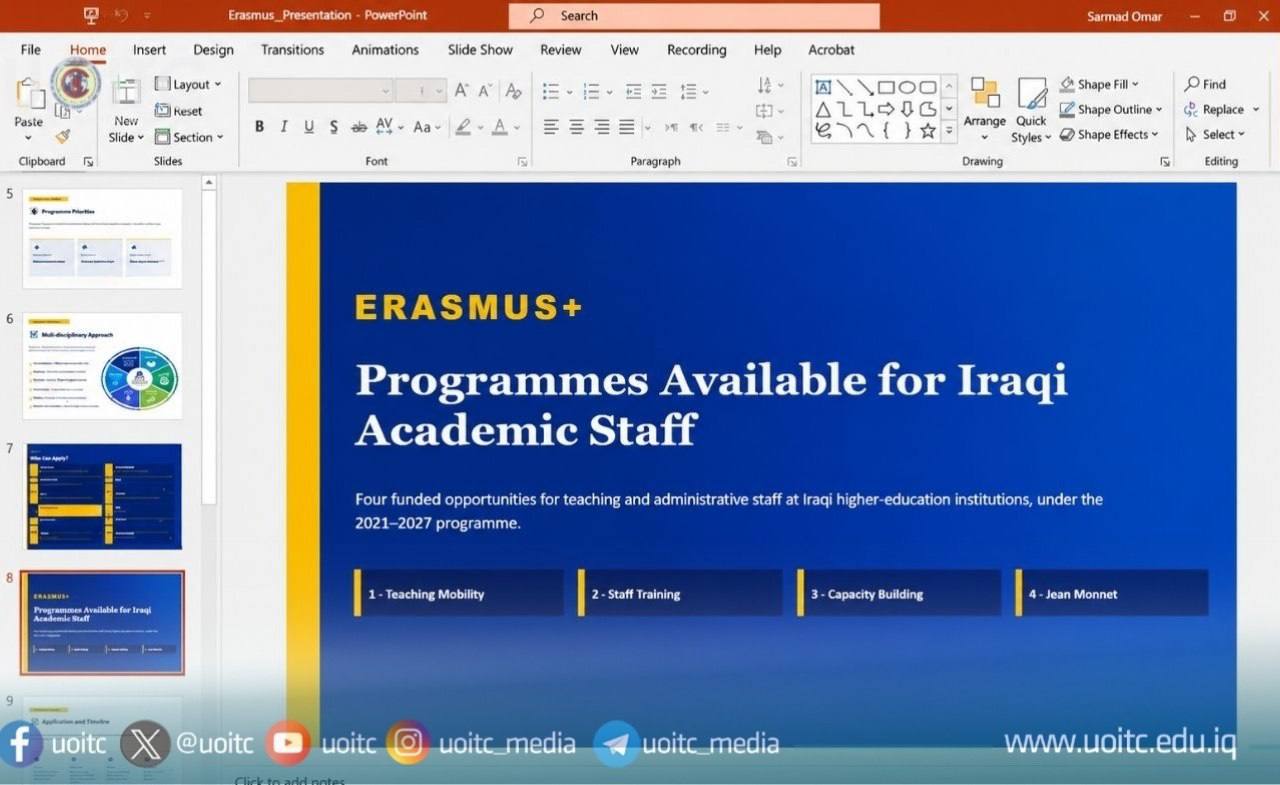
Virtual Lecture to Introduce Erasmus+ Programs and International Academic Cooperation Opportunities
The Department of Scholarships and Cultural Relations, in collaboration with the Continuous Education Center, organized an online introductory lecture on Erasmus+ programs, presented by the hrad of Erasmus+ Unit , assist. Lect. Taherah Makki Abdulkareem.
The lecture highlighted the key opportunities provided by Erasmus+ programs in the fields of academic exchange, institutional capacity building, and the implementation of joint international projects. It also explained the application mechanisms and how to benefit from the grants and programs available within the framework of the program, emphasizing the importance of enhancing academic partnerships and opening up to global universities and educational institutions, contributing to the development of the educational and research environment.
This lecture is part of the university’s efforts to promote the culture of international programs and introduce opportunities for academic and research development, thereby enhancing its scientific presence and supporting avenues for cultural and academic cooperation at the international level.
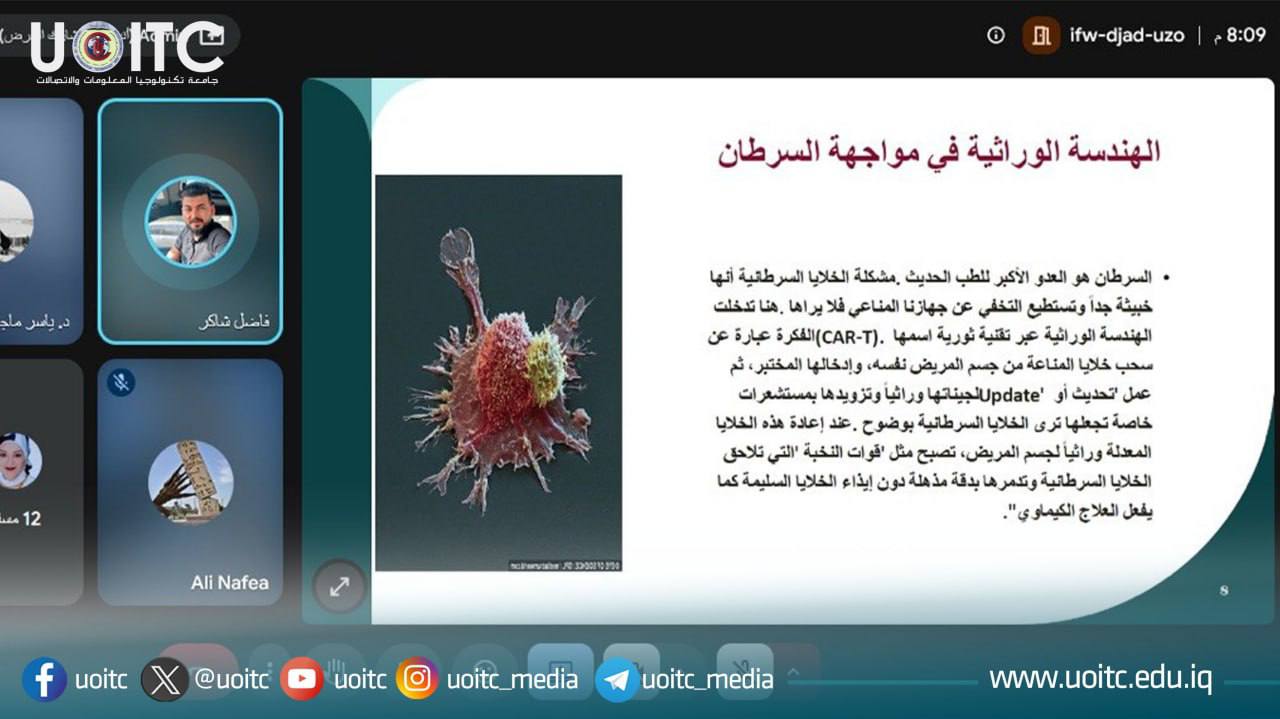
The University Psychological Counseling Division Holds an Online Seminar on Genetic Engineering and the Future of Medicine
The University Psychological Counseling Division, in cooperation with the Continuing Education Center at the University of Information Technology and Communications, held an online scientific seminar entitled “Genetic Engineering and the Future of Medicine,” presented by Mr. Fadhil Shaker Hammoud, a faculty member in the division.
The seminar addressed recent developments in the field of genetic engineering and gene editing, and their role in bringing about a qualitative transformation in modern medicine and healthcare. It reviewed the concept of DNA as the genetic code responsible for transmitting the genetic information that determines human traits and vital functions, explaining the impact of genetic mutations on the emergence of many genetic diseases.
The seminar also highlighted the historical development of genetic engineering, culminating in CRISPR-Cas9 technology, which is considered one of the most prominent scientific achievements of the 21st century due to its advanced capabilities for highly precise gene editing. The seminar addressed the most important medical applications of these technologies, including the treatment of inherited blood disorders such as sickle cell anemia, the development of targeted immunotherapies for cancer, and the treatment of some cases of inherited blindness. It also discussed the move towards personalized medicine, which relies on genetic analysis to design treatments tailored to each patient’s genetic characteristics.
The seminar explored the future prospects of genetic engineering, including the potential for early diagnosis of genetic diseases and the transplantation of genetically modified organs. It also addressed the ethical and legal challenges associated with modifying human embryos and the creation of genetically engineered babies, emphasizing the importance of establishing regulations to ensure the safe and responsible use of these technologies.
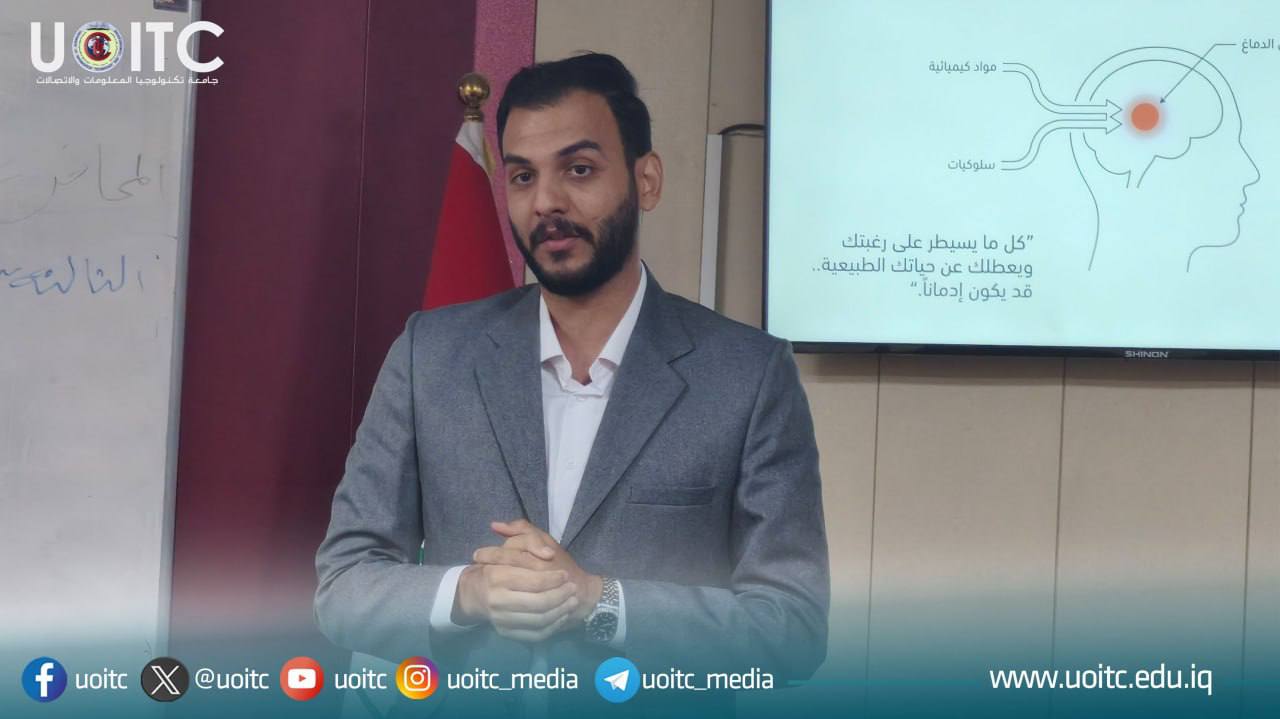
The Faculty of Engineering held an awareness seminar for Master’s students on the dangers of addiction and mechanisms for preventing it
The College of Engineering at the University of Information Technology and Communications held an awareness seminar for Master’s students as part of the Graduate Student Training and Development Program, entitled “Hidden and Overt Addiction: Challenges and Prevention Methods,” presented by Dr. Ahmed Yahya, a lecturer in the Department of Media Technology and Communications Engineering.
The symposium highlighted the phenomenon of addiction in its various forms, both overt and covert, and the psychological, social, and health effects it leaves on the individual and society, in addition to reviewing the most prominent factors leading to it and ways to reduce its spread through the adoption of awareness programs and effective preventive measures.
The seminar addressed the importance of early awareness of the dangers of addictive behaviors and the role of the educational and community environment in promoting prevention of them, which contributes to building an academically aware personality capable of facing contemporary behavioral challenges.
The lecturer stressed the importance of establishing a culture of mental health and adopting positive lifestyles that contribute to promoting psychological and physical balance, pointing to the pivotal role that academic institutions play in raising students’ awareness and providing a supportive and safe educational environment that contributes to developing their scientific and personal abilities.
All Of US
Pages
- About Center of Continuing Education
- About Engineering
- About Us
- About_us_bic
- administrative Departments
- Archive
- Assistant Rector for Administrative Affairs
- Assistant Rector for Scientific Affairs
- Bioinformatics Department
- Business Informatic College
- Business Informatics college courses
- Business Informatics college News
- Campus
- Center for Continuing Education
- Center for Continuing Education News
- Citizens Affairs
- College of Biomedical Informatics
- College of Engineering
- College of Medical Courses
- College of Medical News
- Contact Us
- Contact Us
- Contact Us Form
- contact_us_bic
- contact_us_cec
- Courses
- Deans Of Colleges
- Department of Media and Government Communication
- departments_cec
- Download Center
- Electronic Computer Center
- Embed External Page
- Eng test
- Engineering Contact Us
- Engineering Courses
- Engineering Events
- Engineering News
- Engineering Students
- events_cec
- Fellowship Programs
- Goal 1: End poverty in all its forms everywhere
- Goal 10: Reduced Inequalities
- Goal 11: Sustainable Cities and Communities
- Goal 12: Responsible Consumption and Production
- Goal 13: Climate Action
- Goal 14: Life Below Water
- Goal 15: Life on Land
- Goal 16: Peace, Justice and Strong Institutions
- Goal 17: Partnerships for The Goals
- Goal 2: Zero Hunger
- Goal 3: Ensure healthy lives and promote well-being for all at all ages
- Goal 4: Quality Education
- Goal 5: Gender Equality
- Goal 6: Ensure access to water and sanitation for all
- Goal 7: Ensure access to affordable, reliable, sustainable and modern energy
- Goal 8: Decent Work and Economic Growth
- Goal 9: Industry, Innovation and Infrastructure
- intellgent media system
- Intelligent Medical Systems Department
- International Open Courses
- International Students
- ism department
- lastnews
- Latest News
- mc_EVENTS
- mc_Students
- Media and Documents
- Media and Documents ( Cloned )
- Media Technology and Communications Engineering Department
- Medical College Page
- Mobile Communications and Computing Engineering Department
- News
- Performance Evaluation Forms 2023-2024
- Post-Graduate of Engineering
- Presidency departments
- President of University
- Quality Assurance Archive
- Quality Assurance Department
- Related Websites
- Scholarships and Cultural Relations Department
- Scholarships for Foreign Students
- Scholarships for Foreign Students 2025- 2026
- Scientific Affairs Departments
- Services
- SiteMap
- statistics_cec
- Structural uoitc
- Supporting innovation by generating new ideas to enhance creativity and develop the institutional work of university staff
- Sustainability Website
- Technology incubator
- test10
- test100
- test11
- Test22
- University
- University and Community
- university and society
- University and Students
- University Council Secretariat
- University Home
- UoITC Rank
- Women’s Affairs
- الرئيسية 2