
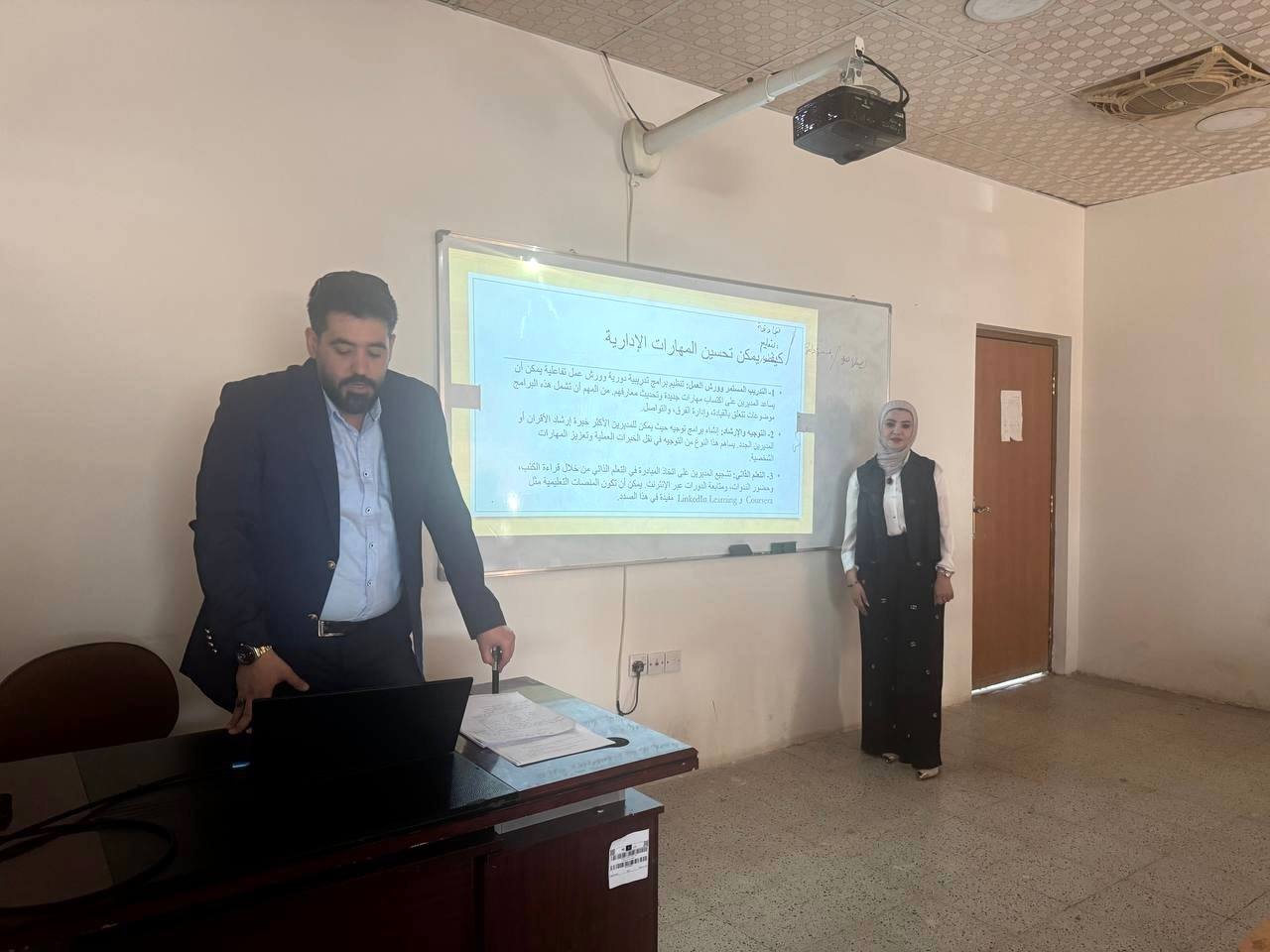
College of Engineering Organizes Seminar on Developing Administrative and Financial Skills
The College of Engineering, in cooperation with the Continuous Education Center , and within the directives of the Ministry of Higher Education and Scientific Research as well as the implementation of the National Strategy for Education programs, organized a scientific seminar entitled “Developing Administrative and Financial Skills.” The seminar was delivered by Assistant Lecturers Farqad Shakir Abd and Safa Dhafir Salem.
The seminar addressed the importance of developing administrative and financial skills in improving institutional performance efficiency and enhancing the academic and administrative work environment. It also reviewed the most prominent modern methods adopted in the fields of administration and financial organization.
The seminar was attended by a number of faculty members and employees and comes within the framework of the scientific and developmental activities that the college is keen to organize with the aim of developing capabilities and raising the level of skills in a way that supports the educational and administrative process at the university.
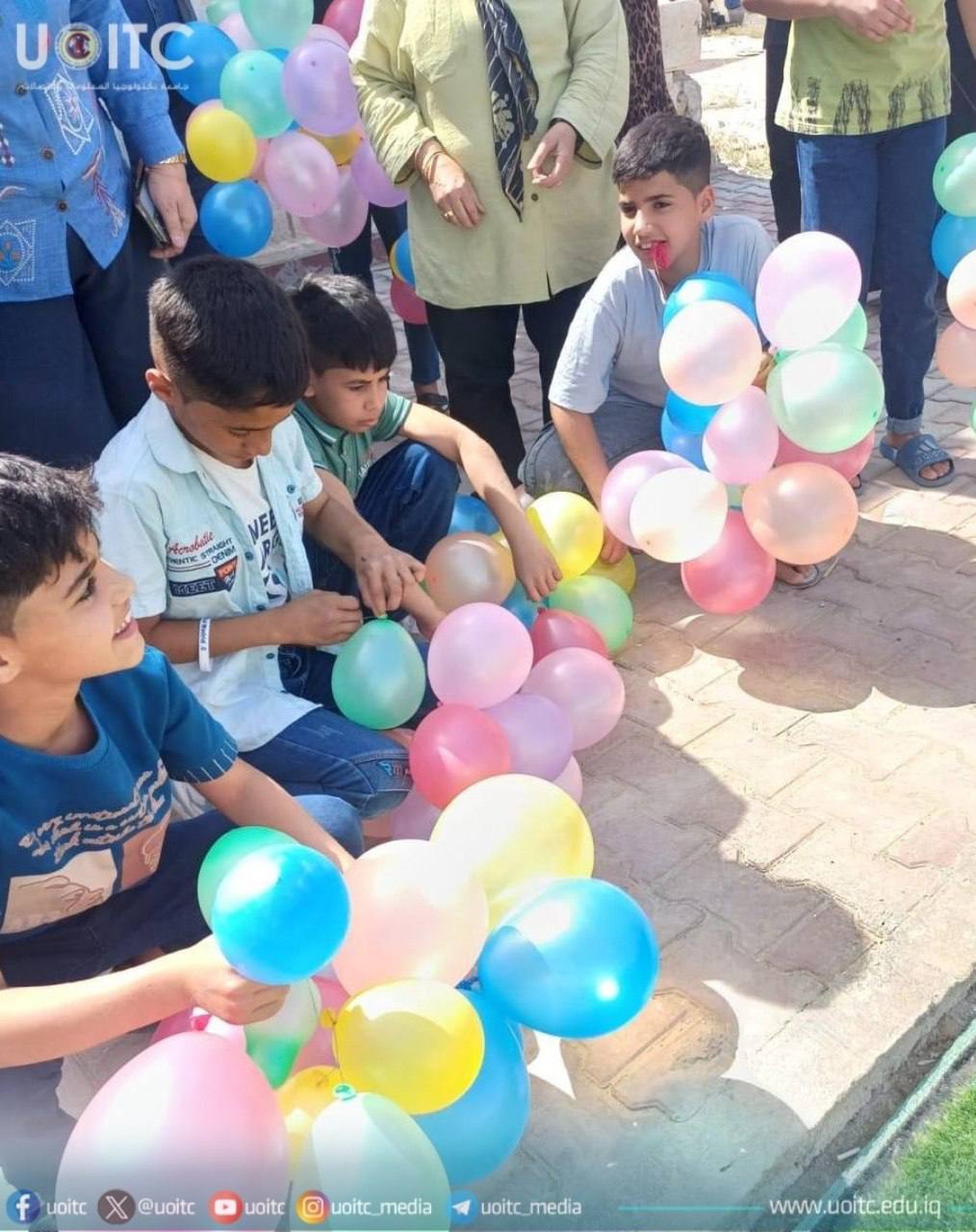
A Visit Organized by the College of Business Informatics to Al-Baraem Orphanage in Al-Muthanna Governorate
In line with the principles of social solidarity and the promotion of humanitarian cooperation, the College of Business Informatics at the University of Information Technology and Communications (UoITC) organized a humanitarian visit to Al-Baraem Residential Orphanage in Al-Muthanna Governorate.
This visit was organized with the participation of a number of the college’s faculty members and staff.
It included the provision of essential supplies for the orphaned children, including clothing, magazines, and toys, as part of an initiative aimed at meeting some of their needs and bringing joy to their hearts. The delegation also reviewed the children’s living conditions and listened to a briefing on the efforts made by the orphanage administration to care for them and provide a suitable environment that ensures their healthy development.
The College Deanery affirmed that this visit comes within a series of humanitarian activities and initiatives that the college is keen to implement as part of its commitment to social responsibility.
The deanery also praised the efforts of the participants and their active contribution to the success of this voluntary initiative.
At the conclusion of the visit, the participants expressed their happiness at taking part in this humanitarian initiative, which reflects the values of giving and belonging, while commending the warm reception and cooperation shown by the administration of the orphanage in Al-Muthanna Governorate.
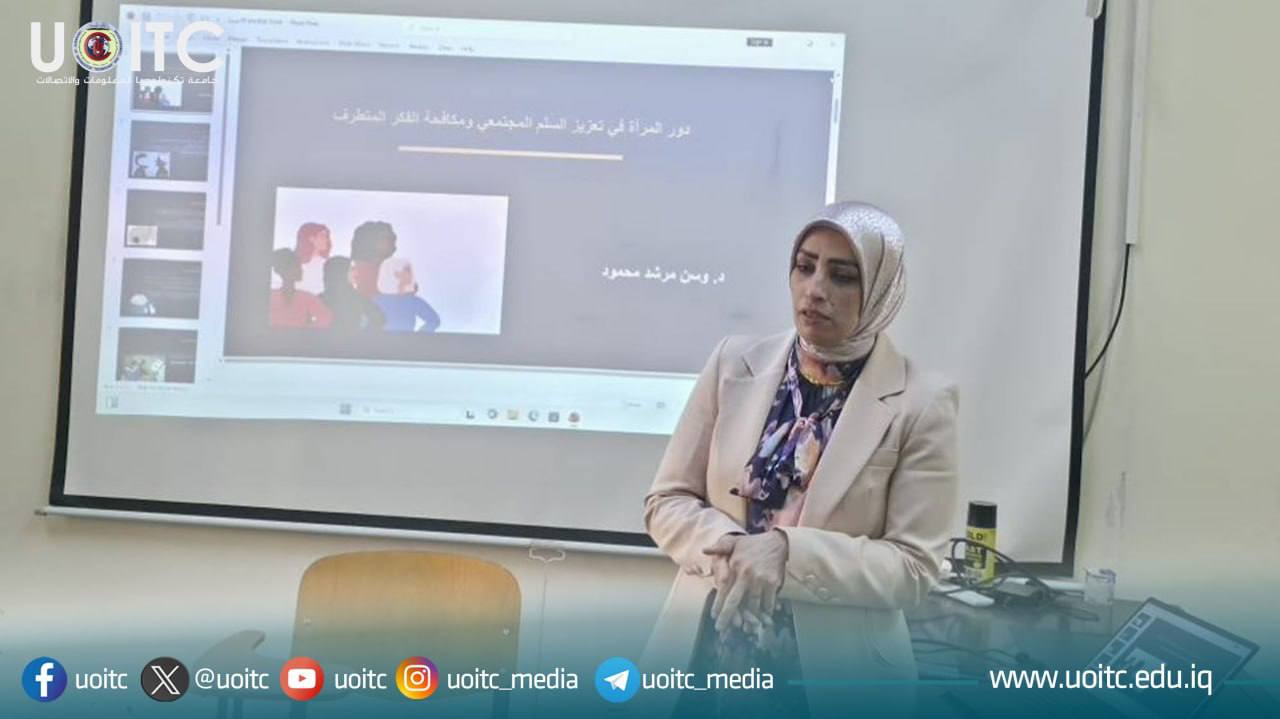
Biomedical Informatics Organizes a Seminar on the Role of Women in Promoting Social Peace and Combating Extremist Ideology
The Women’s Affairs Unit at the College of Biomedical Informatics, University of Information Technology and Communications (UOITC), organized an educational seminar titled “The Role of Women in Promoting Social Peace and Combating Extremist Ideology.” This initiative is part of the college’s ongoing efforts to raise social awareness and establish a culture of moderation.The seminar, presented by Dr. Wasan Murshid Mahmoud, highlighted the pivotal role women play in building a cohesive society based on the values of tolerance and peaceful coexistence. It emphasized her direct influence in nurturing future generations and instilling concepts of moderation while rejecting violence.The session further explored women’s contributions in the fields of education, media, and community work, affirming her active role in spreading a culture of dialogue and enhancing understanding among various social groups. Additionally, it addressed her capacity to identify manifestations of extremist thought and counter them through effective intellectual and awareness-based methods.This seminar is part of a series of university activities aimed at empowering women and strengthening their role in supporting social stability and addressing contemporary intellectual challenges.
All Of US
Pages
- About Center of Continuing Education
- About Engineering
- About Us
- About_us_bic
- administrative Departments
- Archive
- Assistant Rector for Administrative Affairs
- Assistant Rector for Scientific Affairs
- Bioinformatics Department
- Business Informatic College
- Business Informatics college courses
- Business Informatics college News
- Campus
- Center for Continuing Education
- Center for Continuing Education News
- Citizens Affairs
- College of Biomedical Informatics
- College of Engineering
- College of Medical Courses
- College of Medical News
- Contact Us
- Contact Us
- Contact Us Form
- contact_us_bic
- contact_us_cec
- Courses
- Deans Of Colleges
- Department of Media and Government Communication
- departments_cec
- Download Center
- Electronic Computer Center
- Embed External Page
- Eng test
- Engineering Contact Us
- Engineering Courses
- Engineering Events
- Engineering News
- Engineering Students
- events_cec
- Fellowship Programs
- Goal 1: End poverty in all its forms everywhere
- Goal 10: Reduced Inequalities
- Goal 11: Sustainable Cities and Communities
- Goal 12: Responsible Consumption and Production
- Goal 13: Climate Action
- Goal 14: Life Below Water
- Goal 15: Life on Land
- Goal 16: Peace, Justice and Strong Institutions
- Goal 17: Partnerships for The Goals
- Goal 2: Zero Hunger
- Goal 3: Ensure healthy lives and promote well-being for all at all ages
- Goal 4: Quality Education
- Goal 5: Gender Equality
- Goal 6: Ensure access to water and sanitation for all
- Goal 7: Ensure access to affordable, reliable, sustainable and modern energy
- Goal 8: Decent Work and Economic Growth
- Goal 9: Industry, Innovation and Infrastructure
- intellgent media system
- Intelligent Medical Systems Department
- International Open Courses
- International Students
- ism department
- lastnews
- Latest News
- mc_EVENTS
- mc_Students
- Media and Documents
- Media and Documents ( Cloned )
- Media Technology and Communications Engineering Department
- Medical College Page
- Mobile Communications and Computing Engineering Department
- News
- Performance Evaluation Forms 2023-2024
- Post-Graduate of Engineering
- Presidency departments
- President of University
- Quality Assurance Archive
- Quality Assurance Department
- Related Websites
- Scholarships and Cultural Relations Department
- Scholarships for Foreign Students
- Scholarships for Foreign Students 2025- 2026
- Scientific Affairs Departments
- Services
- SiteMap
- statistics_cec
- Structural uoitc
- Supporting innovation by generating new ideas to enhance creativity and develop the institutional work of university staff
- Sustainability Website
- Technology incubator
- test10
- test100
- test11
- Test22
- University
- University and Community
- university and society
- University and Students
- University Council Secretariat
- University Home
- UoITC Rank
- Women’s Affairs
- الرئيسية 2